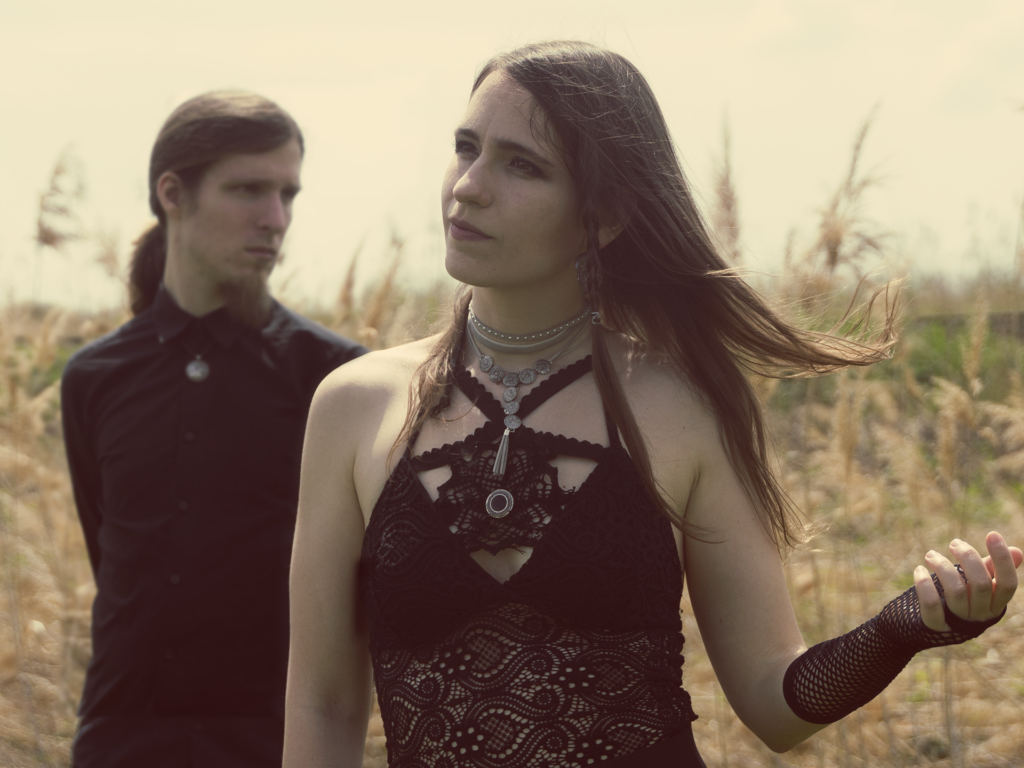
Today, our journey takes us to Hungary, where ancient traditions collide with modern soundscapes. The dark electro-folk duo Itinera – consisting of Anett Horváth and Ádám Nagy – has been turning heads across the European festival circuit with a mesmerizing blend of the past and the future.
You both have roots in the symphonic metal band Leecher, yet you formed Itinera in 2022. What inspired the shift from heavy metal to this shamanic, electro-folk sound? And what does the name ‘Itinera’ – meaning journeys or paths – signify for you personally?
[Adam] Back in 2019 with Leecher everything was going very well, we had a signed contract to tour Europe as an opener in an actual nightliner bus, which had been our Big Dream. Now, the information that the tour was scheduled to April 2020 tells everything, I guess… for some years it was unclear whether it would ever again be possible to do anything with a band, and so by the time touring was an option again, it was practically impossible to pull the band together.
With Anett we had been writing music for a long while, we wrote most of the second Leecher album together, but really we were never strictly metal musicians, we wrote and listened to a quite broad range of music, that is, roughly from Dead Can Dance all the way to early Cradle of Filth, haha. And so we decided that we wanted to make music together anyway even if Leecher is not working well now. So, we got ourselves some new instruments, Anett a looper station, and I took a dive into Ableton Live, and we just experimented with a lot of different things. Anett has always had a thing for folk music from her childhood and I was really into the cultural history side of magic and mysticism, so eventually we ended up with this strange combination, I mean, we did not sit down to make a specific genre of music, it just happened. Actually when I tried looking up the name for what we were doing, I had a really difficult time. Someone said folktronica but anything I found did not sound like us. So we had to kind of invent a name, we think “dark electrofolk” describes it?
As for Itinera… we wanted a name that we could use internationally and considering the weirdness of Hungarian pronunciation for basically everyone outside of our country (and that it might mean something in other languages), we decided we should find another language. Having an English name for a band built on Hungarian folk/folklore was also a weird option, so we went for Latin. Originally it was a factor in the naming that we relied more heavily on looping, or iteration, so to say, but we can also say that “journeys” is a good name for something that is rooted in folklore but is also not traditionalist but somewhat fantasy.
Music is clearly deeply rooted in both of you. What was your musical upbringing like, and were there specific moments that laid the foundation for the path you’re on today?
[Adam] My parents were kind of part of the Hungarian musical world, but surprisingly, when I was young I did not care about music making at all. Then in high school I became a big metal fan, specifically I loved the early Apocalyptica albums, so with one of my classmates (with whom we later founded Leecher) we started playing cello. Also back in 2005 our district had this big event, Carmina Burana sang by about a thousand students and we were part of that big choir, then I decided that this was so epic I wanted to write my own magnum opus. That is how we started writing music which eventually started to have metal elements and became Leecher. Then on the way I became acquainted with DAWs, VST instruments and so on, then Itinera opened up another part of this world. In the meantime, thanks to some unexpected turns, I got a tagelharpa (multiple, actually), which we now incorporate into our shows and hopefully our next album. However I am not a producer, I leave that to the pros, I can only make decent sounding demos and prepare tracks and projects for mixing.
[Anett] I joined the folk dance group of Nagyiván (the village I grew up) at the age of 9, that was my first experience with folk dancing and singing. Anyway, I learnt some music theory, flute & piano, I learnt to play the guitar by myself, then I went to many classical singing teachers… so my journey is quite long.
You’ve described your dark folk style as a “Trojan Horse” used to smuggle Hungarian folk music to an international audience. How has the reaction from the scene been so far?
[Anett] People are always interested in our culture, history and language, which is a very good thing to experience. I think they find it most interesting that the Hungarian language is very unique, not really similar to anything else. The audience hears the familiar darkfolk elements and sounds in our music, but as it is combined with a language and melodic world they have never heard, it gives them a well-known, but in the meanwhile, very new feeling – and I think they like it!
Your music stems from the belief that facing and accepting our own dark side makes us better people. How did you weave this philosophy into your latest full-length album, *Kör*?
[Adam] Well, the overarching concept of the album is a circle of a year, which can already be thought like a parallel for human life. We usually deal with dark introspective themes in our song lyrics. A few examples would be… “Mindentlátó” is a shamanic initiation rite, but these are always about metaphorically dying and being reborn, going down and inside and emerging as a more powerful person. “Umbra” is about being called by a dark figure and then realising it is your own dark side, and making peace with it. “Őszi dal” is about accepting the passing of summer and the arrival of the dark half of the year, which can of course be thought of as accepting the loss of good things. And so on. I very firmly believe that if we do not make peace with our fears, they will cause trouble in the very areas they were meant to protect us from. A blunt example would be, if one accepts that they do not need to be richer to be loved, then maybe they will not become a crazy billionaire with endless hunger, eventually ending up being hated by millions.
Let’s talk about your brand-new collaboration, “Idegen,” with Alchimyst and Total Balance. How did this electronic crossover of your original track actually come to life?
[Anett] Our dear friend Aeriké introduced us to each other with Total Balance. He already did a cover for ‘Pirkadat’, but he also found inspiration in ‘Idegen’. Honestly, this style is a bit far away from us but we have just started to dig deeper in the world of electronic music genres.
Looking ahead, are there any specific artists or producers you would love to collaborate with in the future?
[Adam] A lot! Actually, there are already some happening, or at least, in the state that we should be writing music for them, haha.
[Anett] Yeah, a lot! We were impressed by the music of Weljar and STFUR, so we’d like to work with them very much and Vígundr is one of my favorite producers in the genre, so I’d be very happy to create a song together with her! Plus, we already created a song with Realecta, but I hope for more collabs because I like the way his shamanic bass rips my face off 🙂 .
The visual aesthetic is a huge part of Itinera’s world, especially with your handmade, nature-inspired costumes. How important is this physical transformation for putting yourselves – and the audience – into a trance-like state during live shows?
[Adam] Well, this band has been playing live for just somewhat more than three years, so unfortunately I am usually too nervous to be in a trance during shows, especially because we always introduce some new element and are afraid of how it can go wrong, haha. But yes, a live show is basically performing hypnosis, the key to it is to enchant the audience, so to say, to give them an illusion that they have managed to escape ordinary reality for some time, and visuality is a big part of that. It also helps to draw a line for yourself, so you know that you are not your everyday self. These boundaries have been important in any kind of ritual, being a symbolic and often physical separation of the sacred and profane realms.
[Anett] My clothes and looks are very important for me to get in a concert mood. It’s my ritual to put on my face painting, my headdress and I even have my concert jewellery which “gives me physical and mental strength” during the show. I like to think that when I’m wearing those, I’m a different person, who is ready to bring immersion and fun to the audience and can help them to connect to their transcendental worlds.
Are you personal believers in the old pagan and shamanic traditions you explore, or is your art driven more by a deep historical and cultural fascination?
[Adam] Well, first of all I find any mystical tradition and religion quite fascinating from a cultural point, an incredible array of human inventions to make sense of all the universe around us. Modernity and postmodernity are very proud about their discovery that myths and gods are “lies”, but they forget that these exist specifically because the alternative is absolutely terrifying: your life is an accident, it does not have any “meaning” and it will inevitably end, also everything you believe is just human mental inventions. And we are surprised that people are depressed on a global scale.
But to try to get an answer, I have a weird mix of belief and non-belief, it could best be explained by the so-called models of chaos magic. They state that the world can be explained in multiple ways, and neither is better than the others. You can say that there are gods and spirits and you can ask/coerce them to help you; you can say there is energy like chi or mana, and you can manipulate it; and you can also say that it is all just externalised names for internal mental phenomena ad personifications of concepts, like we venerate gods because it is much easier for our monkey brains to talk to a “goddess of beauty” than to interact with “beauty” as an abstract concept. So, with all this considered, I have personally built my own system, which is a mix of some very abstract stuff and a more pagan-like nature-centered thing. It is not directly related to any tradition, but hey, some of my rituals have worked quite well.
Also it is noteworthy to say that our music is not in any way traditionalist, while we are inspired by actual folklore, we do not aim to accurately recreate anything. There are bands that do this much better than we ever could.
[Anett] I regularly do small rituals which draw from old/occult/shamanic mythology. I wouldn’t say I’m a believer, it simply makes me feel calm and good. I also find pagan/esoteric symbolism or astrology beautiful (lately I’ve been collecting minerals). I’m really interested in how people feel connected to their transcendental worlds, and I’m fascinated by their way of thinking. Basically, I search for scientific reasons in everything, but when I write songs about shamanic/traditional mythologies and beliefs, I feel like I’m able to express the feelings and thoughts of these people from the present and also from the past. It makes me feel like I’m also part of this magical world… and I definitely want magic in my life!
Where do you typically go when you need inspiration for new chants and melodies? Do you actively seek out nature and landscapes, or does the creative spark usually happen organically during studio sessions?
[Adam] Fortunately we live near a small, let’s say forest, so if we want or need some nature, it is ten minutes away, if you don’t count the city noise that unfortunately can break in there, but that’s what headphones are for. As for the creative process, it happens completely randomly, sometimes you sit down with the specific intention of making music and nothing happens for two hours, and sometimes you randomly get an idea and spend two days straight on it (well, except work and other wordly annoyances) and you have a song. But the usual process is, Anett works with vocals and I work with music, usually one of us makes some kind of demo and the other continues it.
[Anett] When I look for inspiration, I usually go to my folk songs and ballads collections, to my books about shamans and Hungarian traditions, superstitions, psychology or even to occultism/astrology. Sometimes I just have a simple feeling and the melody is automatically coming along with it (like it happened with “Őszi dal” /Autumn Song/.) But some weeks ago I had a very interesting idea on how to get more inspired by nature, now I want to start experiencing how it works. Cheer for me! 🙂
What are the next steps for Itinera? Are there any specific myths or new stories you are eager to tell next?
[Anett] There are so many ideas in my head I want to talk about in our songs! I have a lot of abandoned lyrics, inspiring topics, old stories I want to cover… for example I want to draw more from old Hungarian superstitions and folk customs because they are very dark in a unique way (last time I read that it was believed in the old times that if a little child gets sick, the cause of the sickness can be someone, or something that had scared the child. The scared child can be cured in many strange ways, but the strangest is that you have to make them drink from a skull. How dark is that! 🙂 )
However, the fact that the two of us should do all administrative work around the band from travel plans to concert organisation makes the creative process a bit slower but I believe in the end I can tell everything I want on the next album. This world is full of magic and I really want to share it with others.
Thank you for your Time
Links