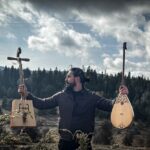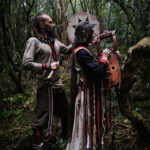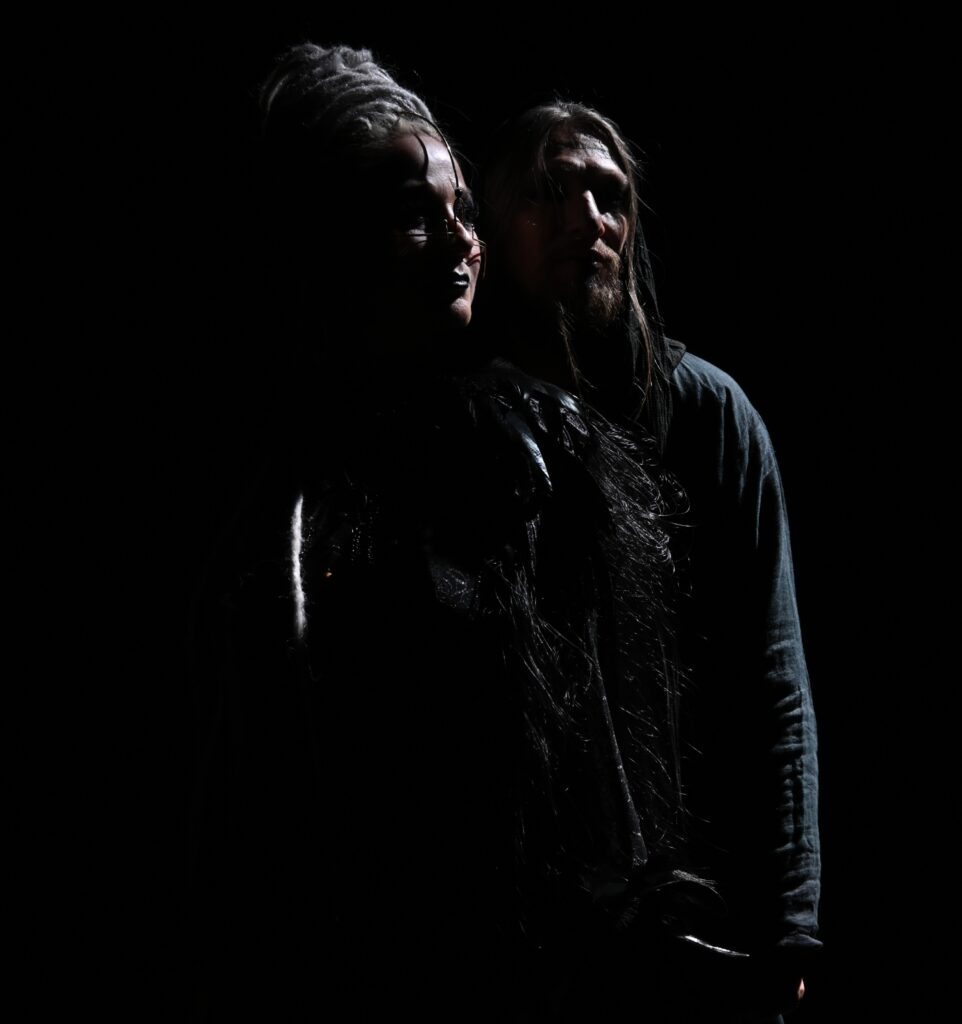
HRAFNGRÍMR is a Nü Nordic / Dark Pagan group.
The group has released 14 singles and 1 EP & 1 LP offering contemporary lyrics in the language of the Vikings accompanied by modern and immersive music using both traditional and current instruments.
We are happy that you found the time for this written interview, we are all
looking forward to hear more about your music journey
Where do you all come from in Hrafngrímr?
Mattjö: We all live in France
How many are you in the band?
Mattjö: We are five musicians and vocalists: Mus, Christine, Arnaud, Nesh, and myself. In addition, we work with two dancers and performers, Sam and Clara.
We also consider our sound engineer and lighting designer as full members of the band, as they are deeply
involved in the creative process. Yoann handles sound, and Nil is in charge of lighting.
What does “Hrafngrímr” mean, and do it have a special meaning for you?
Mattjö: Hrafngrimr is a constructed name inspired by Old Norse.
“Hrafn” means raven, a symbol of memory and perception, and “Grímr” refers to the mask, the hidden figure,
and transformation.
How long have “Hrafngrímr” been around and how have the musical journey been?
Mattjö: Hrafngrimr was born in late 2019, following my departure from SKÁLD. For many years, I had been searching for a project that could be deeply authentic-artistically, humanly, and almost socially one capable of connecting what is most meaningful in both the past and the present.
Authenticity is central to our approach: in the musical creation, in the emotions shared on stage, and also in the lyrics, which we write ourselves before having them translated into Old Norse.
These are contemporary texts, rooted in the world we live in, offering a lucid and constructive critique
of our time, its paradoxes, and its contradictions.
Have you always played this kind of music?
After years of artistic experience, historical reenactment, and personal commitment, I felt I had reached the maturity necessary to carry this vision forward. Hrafngrimr was born out of that necessity: to propose a modern, sincere, and fully embodied neo-Nordic aesthetic. Today, our music is fully modern and contemporary.
It blends traditional instruments and techniques with current ones, both in sound and in production.
In terms of energy and intention, we see ourselves less as a “pagan” band and much more as a rock or
metal band, with a raw, direct and contemporary approach.
Mattjö: Not exactly. I spent many years searching for this kind of music before actually creating it myself. I
discovered it around 2009 with Wardruna, at a time when the band was still quite confidential. I was probably among their early listeners, and I immediately connected with the traditional and ritual dimension that I couldn’t find elsewhere.
However, it was only later, when I joined SKÁLD, that I was truly initiated into performing this kind of music
myself. As for the other members of Hrafngrimr, this is their first project within this aesthetic and approach.
Have you done any collabs and would you like to share with whom?
Mattjö: Yes, we’ve already had the chance to collaborate with Nytt Land, who are close friends. I really love working with them because they bring a very different perspective and inspiration, which always leads to something meaningful and enriching.
More broadly, I’m very influenced by the work of Max Cavalera, especially his approach in projects like
Soulfly, where collaborations and guest appearances play a big role. I really like that idea of featuring other artists – sharing songs, creating together, having fun with it, a bit like what you see a lot in hip-hop as well.
For us, collaboration is also about enjoyment and exchange. And yes, I would absolutely love to do more collaborations in the future, including with some of my heroes – whether that happens one day
or not, we’ll see.
Do you have a favorite track yourself or maybe a band?
Mattjö: It’s very difficult for me to choose a single favorite track or band.
I’m extremely curious by nature, and I constantly like to explore and draw inspiration from many different genres and styles.
That said, my very first musical crush – the one that made me want to make music in the first place—was Nirvana. As a teenager, I spent a lot of time studying the symbolic and poetic writing of Kurt Cobain, and I’ve kept some of that approach in my own way of writing. It’s also what later led me to explore poetry and authors like Charles Baudelaire and Arthur Rimbaud.
If I had to name artists who influenced me the most within the pagan and ritual scene, it would definitely be Wardruna, Nytt Land, and Heilung – and I’m surely forgetting many others.
On the metal side, the list is even longer: bands like Korn, Sepultura, Soulfly, DevilDriver, Deftones, and many more. And that’s without even mentioning electronic music or hip-hop. So, choosing a single favorite song is almost impossible for me.
Do you believe in the old ways yourself?
Mattjö: Yes, I do – but in a very modest and humble way. For me, this is a philosophy of life, not a dogma, and I approach it with great care and responsibility.
In our songs, I often repeat a simple idea: the gods will not do for us what we are not willing to do for ourselves.
Each of us must be the artisan of our own destiny. This is an idea that can be found in the Hávamál, and it
strongly resonates with the way I understand responsibility, choice, and consequence.
That’s why I’m extremely cautious with anything related to runes, shamanism, magic, or esoteric practices.
For example, I don’t have any runes tattooed on my body. This doesn’t come from ignorance, but from respect and restraint.
I don’t live these beliefs as a social identity, a label, or a way to belong. They are something much deeper and sincerely lived – something that has shaped who I am and guided important choices in my life.
It’s not a shell or a way to stand out – it’s an inner path, which I prefer to express through music rather than
through dogma or discourse.
Where do you find your inspiration for your music?
Mattjö: My inspiration has always come from emotions. From what I’m going through, what affects me deeply, the causes I care about, the things that shock or revolt me.
Very often, I feel the need to shout – or even scream – the paradoxes of our society: injustice, inequality, war, death.
After more than fourteen thousand years of conflict and destruction, I believe humanity should be capable of building solidarity, still equity, and a form of universal freedom, while fully respecting cultural
differences, ways of life, and traditions.
We live in a world that has enough resources for no one to suffer from hunger, extreme poverty, or preventable diseases anymore. I’m aware that this revolt comes from a position of privilege – I’m a European living in relatively safe and comfortable conditions. But that awareness comes with responsibility.
For me, life is sacred. Children are sacred. Women and men are sacred. Animals, plants, and nature are
sacred. Everything is interconnected, part of the same living ecosystem.
That’s what I try to express through music: not to impose ideas or make people feel guilty, but to awaken
something, to share a sensitivity and a vision of the world. Of course, this is my personal perspective – each
member of the band has their own sources of inspiration.
Does any of you have any music education, or have you learned yourself?
Mattjö: In my case, I started quite late, and my knowledge of music theory is fairly basic. I do recognize that
having a musical education can be very useful – it gives you a shared language to work with others and to
better understand what you’re doing – but it’s absolutely not mandatory.
I strongly believe that unlimited inspiration, without barriers, rules, or strict frameworks, can be incredibly
powerful. Sometimes, having too many codes in mind can actually become a limitation. On the other hand,
those same codes can also be valuable tools or supports.
Personally, I didn’t have an advanced or academic musical education – just some basic foundations—and
that’s enough for the way I create and express myself.
How many instruments do you play on in the band?
Mattjö: I’m primarily one of the lead vocalists, alongside Christine. On stage, I mainly focus on vocals, but I
also play jaw harp, drums, and various percussion instruments, and I do a lot of programming as well. There’s
a clear difference between what I play live and what I do in the studio. In the studio, I sometimes record
additional instruments – strings, wooden flutes, water instruments, and other percussions – depending on the needs of the songs.
So, my role really shifts between performance and studio work, always in service of the music.
Can it be hard to find time for music, when work an life in general comes in?
Mattjö: Yes, it can definitely be challenging at times.
We are fully independent, with our own label and production, and we handle everything ourselves:
graphic design, partnerships, photoshoots, video clips, recordings, marketing projections, and even
booking. It’s extremely time-consuming.
Our creative process also works in cycles and impulses. Sometimes I’m in a strong creative phase, sometimes it’s Christine, sometimes Mus. It all depends on timing, availability, and emotional
states, and those aren’t always synchronized.
At the same time, this independence is possible because we’ve built a broader ecosystem around
the band, which allows us to finance Hrafngrímr professionally while remaining fully autonomous in
our choices.
That freedom is priceless: we can work at our own pace, choose when and how to release music – albums, singles, or nothing at all.
So yes, balancing life, work, and music can be difficult, but that freedom and independence are worth the time and effort they require.
Do you have any other interest like sport, crafting or carving – maybe gaming?
Mattjö: Yes, I have many interests, but for me everything is connected – like an ecosystem. Most of them
somehow feed into the band and the project.
Professionally, I’m a graphic designer and community manager, so visual creation and drawing have always
been a big part of my life. Alongside that, I practice living history and historical reenactment with Compagnie de la Branche Rouge, one of the oldest Viking reenactment groups in France. This naturally led me to traditional crafts, but especially to medieval combat, which I really love – even if I don’t get to practice as much as I’d like anymore.
I’m also involved in brewing beer, which is part of the wider ecosystem surrounding the band. And yes, I do
play video games as well. I enjoy strategy games, Viking-themed games of course, but also more
straightforward titles like Battlefield or Call of Duty – sometimes I want something that requires focus, and
sometimes I just want to unwind.
The challenge is finding balance. I’m passionate about many things, and sometimes it’s hard to slow down or
give myself permission to rest. But all these interests shape who I am and, in one way or another, influence
the music and the vision behind Hrafngrimr.
What track or album means the most to you and why?
Mattjö: It’s very difficult for me to choose just one track or album, because many songs are tied to important
moments in my life.
If I had to start with one, it would be SEXTÁNDI, our very first track. It includes an excerpt from the Hávamál- a stanza about courage and perseverance: “The foolish man thinks he will live forever if he avoids battle; but old age gives him no peace, though spears might spare him.” At the time, I had just left SKÁLD under difficult and painful circumstances, so this song became a symbol of rebirth and resilience for me.
Another deeply meaningful track is BLÓT. It’s a tribute to those who are missing – our ancestors, our guides,
and those who are no longer with us. It also contains the last recordings of our friend Mike, who was part of
the band and passed away from Covid. Because of that, I think this song will stay with us forever.
FJORBANN is very personal as well. It’s not one of our most widely known tracks, but I wrote it after my father passed away, and it speaks about the final journey.
Finally, Niflheims auga marks a real turning point in our creative process. It laid the foundations of the
universe we are creating and defending today.
In the end, it really depends on my mood and emotions. Different songs resonate at different times, which
makes it impossible for me to choose just one.
Do you have anything you want to share with us about your music in general, maybe a new
release soon?
Mattjö: We’re planning to release a few singles this year, including some collaborations that we hope will come together, but it’s still a bit early to share more details.
At the same time, we’re already working toward a new album, which is planned for release in 2027.
Any plans of attending festivals In 2026 or other live arrangements?
Mattjö: We already have several festivals scheduled between May and October, even though most of them
can’t be announced yet.
What I can share is that we’ll be playing Castlefest in the Netherlands. It’s a festival I’ve dreamed of playing
for many years. We were supposed to perform there in the past but had to cancel several times – first because of Covid, and earlier when I was still with SKÁLD – so I’m genuinely excited that it’s finally happening.
Overall, we’re looking at around ten live dates this year, but for now, I have to keep the details under wraps.
Do you have a plan for the future for “Hrafngrímr” like a 5-year plan?
Mattjö: As I mentioned earlier, we’re planning a new recording that should take place in one of the
Scandinavian countries. This next chapter will be much deeper and more autobiographical – emotionally
strong, intimate, and intense. That’s a very important direction for us.
At the same time, we are completely reworking our live performance in order to offer the audience a truly
unique, immersive, and meaningful experience. This requires a lot of work, but it’s essential to our approach.
Our goal is not quantity, but quality. We aim to perform live between 15 and 20 shows per year at most, making sure that each one remains a singular, powerful experience for both the audience and ourselves.
We would like to thank you for answering our questions about your music, and glad we could do this
written interview, and we are sure many are happy to get to know you better.
LINKS: