 Click here for the German Version
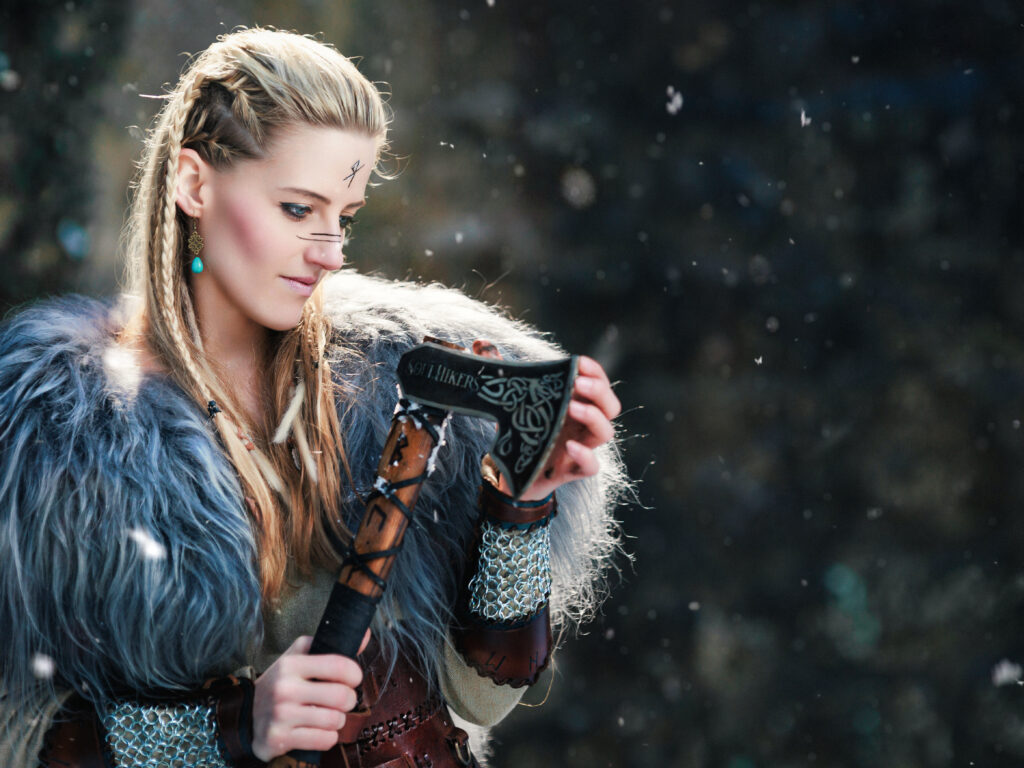
Rahel, better known as SoulHikers, has established herself as an authentic voice in the scene. As a “singing shieldmaiden,” she blends Norse mythology with modern, epic storytelling in her original compositions. We spoke with her about her roots, her craft, and her journey as an artist.
Rahel, thank you so much for your time.
I’m really looking forward to your questions, and thank you for having me!
Music seems to be deeply rooted in you. What was your musical childhood like? Was there a specific moment that laid the foundation for everything else?
Yes, music is my absolute passion; I couldn’t live without it. It might sound exaggerated, but music gives me so much. I’ve had this urge for as long as I can remember—I’ve always wanted to sing and be on stage.
Since when have you been officially active as “SoulHikers,” and what was the vision behind that name?
I wear this name with a lot of pride. “SoulHikers” represents a “wanderer of souls.” Just as a soul can move from one place to another, I move through different musical genres. I don’t like to be pinned down; I sing whatever I feel, ranging from film scores, epic music, and Disney to Nordic music—which is my main focus. It allows me to vary my style, experiment, and “hike” from one genre to the next.
Do you remember the very first song you wrote? What was it about, and how does it sound compared to your style today?
I’m actually not a songwriter myself. I spent years doing covers. For my first original album, Stimme der Seele (Voice of the Soul), I had a lot of help. I chipped in here and there, changing a sentence now and then, but ultimately I’m very grateful to my producer, Jon, who poured all his musical talent into the album. My husband, Nora, and people close to me wrote the lyrics for me.
You use both German and English. How do you decide which language captures the soul of a new song better?
Over the last few months, I’ve met many talented people and started more collaborations. Usually, I’m sent songs and I get to decide if a track is right for me or if it doesn’t move me. That’s how I decide: when I hear a song for the first time, regardless of whether it’s German or English, it just has to go “Boom.” It’s not about the language; it’s about the feeling.
“Valhalla Calling” – your German interpretation exploded and reached millions. Did this massive success surprise you, and why do you think these Nordic sounds resonate so strongly today?
Yes, it surprised me more than I can say; I never expected it. I’m very grateful to “Miracle of Sound,” the creator of Valhalla Calling. I emailed him back then asking if it was okay to cover it. He said yes, and that started my journey into Nordic mysticism.
As for why it resonates, it’s hard to say, yet there’s something slumbering within all of us. The Vikings, the Middle Ages—that is our history, our ancestors. We are all the same, and this music grounds us. It gives a sense of security, of something that was “good” back then. People in the Middle Ages had no choice; they had to be a community to achieve anything. That’s no longer a given today; everyone goes their own way or fights alone. We should be working with each other more, rather than against each other.
Your original songs are the heart of SoulHikers. What excites you more about performing your own songs compared to interpreting covers?
Being able to call songs my own is magical. My voice brings the songs to life and gives them a soul—I’m smiling saying that, but it’s true: instruments and voice shape a song. Knowing there are songs out there that were sung by me for the very first time fills me with pride. It’s exciting because it’s something of your own, not “just” a cover. Though I want to be clear: there’s nothing wrong with covers—you still make them your own in the end.
Where do the stories and melodies for songs like “Soulsong” come from? Are they based on old legends or personal experiences in a modern coat?
“Soulsong” was created with the wish to bring the name “SoulHikers” more to the forefront. By singing about the different runes in the song, we were able to give the concept more visibility. I’d say it’s a mix of old legends and the modern era, though there wasn’t a specific personal backstory behind it.
You run your business as an independent artist. How much do you value this absolute artistic freedom, and where are the biggest hurdles?
It’s great that I can do whatever I want. There’s no one telling me “how” or “what”—though that’s also exactly what I might need to get even further. You know what I mean? A label, a full production team, or management—they have different contacts and many more opportunities than I do.
But I believe in something: everything happens at the right time, or it doesn’t. I follow my dream and work hard for it, but sometimes it takes more than just will and skill. It takes the right moment, the right connections, the right time. I trust that everything will turn out as it should.
Your music is very multifaceted. How much “tweaking” goes into the arrangements until a song breathes the exact atmosphere you imagined?
Strangely, with some songs, the recording and production go so smoothly and easily. Other times, I have to re-record often, or I listen to a “finished” song and think, “Uh, no, I need to go back in.” What I can say is: you have to give yourself time (even if patience isn’t my strength!). If you’re not satisfied, you just have to dive back in before releasing it to the world.
What influence does feedback from your community (e.g., on Twitch) have on your work, and what can we look forward to next from your creative forge?
My Twitch community is amazing; I love their honesty and the great community we’ve become. However, I don’t let the community influence my original songs. If I tried to cater to every critique—positive or negative—I’d never get anywhere. Many people, many tastes!
I have six more new songs that will be released as singles over the coming months. It’s a continuous journey with new songs, live performances, and more.
To wrap things up: If you had one single message for everyone out there, what would you want to tell the world?
Since the first day of “SoulHikers,” there has been a motto I’ve held onto: Stay true to your soul! Everyone should take that to heart. There is so much truth in it. Never change who you are for others; stay as you are and walk your own path.
Rahel, thank you for these deep insights into your world. It’s inspiring to see the heart and soul you pour into your own legends and how authentically you bridge tradition and modern music. We look forward to seeing which paths the SoulHikers take next. Skál!
I thank you from the bottom of my heart for these great questions and the interest in my work. Thank you. Skál!